
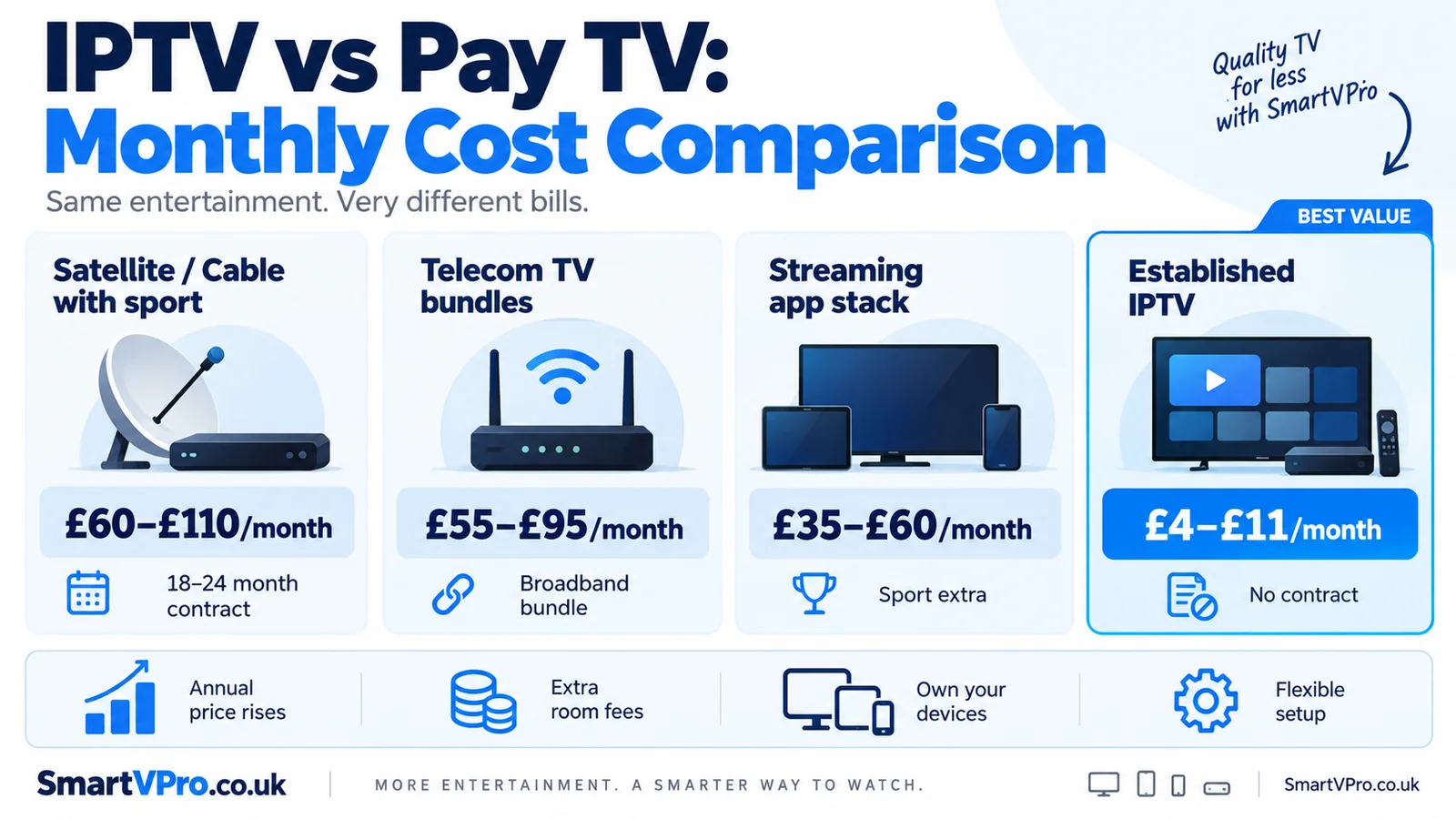
The IPTV vs pay TV question comes down to one number: a full satellite or cable bundle with sport in the UK costs roughly £60–£110 a month on an 18–24-month contract, while an established IPTV subscription costs £4–£11 a month with no contract. Telecom-bundled TV and the streaming versions of the big platforms sit in the same pay-TV range once sport is added. The trade-off is not price; it is guaranteed polish and a single bill versus flexibility, choice of device and a much lower cost.
This comparison puts the 2026 numbers side by side in pounds, explains the contract mechanics that make pay TV more expensive than the headline price, and is honest about what IPTV does not do as well. Pay-TV figures are the widely reported 2026 ranges at the time of writing; check the providers’ own pages before you sign anything, because promotional rates change monthly.

Table of Contents
IPTV vs Pay TV at a Glance: Satellite, Cable, Telecom Bundles and IPTV
| Satellite platform | Cable platform | Telecom-bundled TV | Established IPTV | |
|---|---|---|---|---|
| Entry TV price | about £15/month (basic pack, long contract) | about £30+/month with broadband | about £20+/month with broadband | £4–£11/month |
| With full sport | £60–£100+/month | £65–£110/month | £55–£95/month | included in the same plan |
| Contract | 18–24 months | 18 months | 24 months | None |
| Mid-contract price rises | Yes, annually | Yes, annually | Yes, annually | No; price fixed for the term you paid |
| Hardware | Dish and box, or a streaming puck (rental or fee) | Set-top box (rental) | Box (fee) | Your own smart TV, Firestick or box |
| Devices at once | 1–2 (extra boxes cost more) | 1–3 (extra boxes cost more) | 1 | 1–4 depending on plan |
| Watch away from home | Limited by app | Limited by app | Limited by app | Anywhere with broadband |
| Set-up | Engineer visit or self-install | Engineer visit | Self-install | Log in to an app in 5 minutes |
Two things stand out. First, the entry prices for pay TV look reasonable until you add sport, which is where most of the demand is. Second, the contract column: every mainstream platform now applies an annual price rise mid-contract, so the price you sign for is not the price you pay for two years.
IPTV vs Pay TV: The Real Two-Year Cost
Headline prices hide the total. To compare IPTV vs pay TV fairly, look at what a household pays over a typical 24-month term including the annual increases and the hardware.
| Scenario over 24 months | Pay-TV bundle with sport | Established IPTV (annual, 1 device) |
|---|---|---|
| Monthly price at sign-up | about £75 | £4.00 (paid £47.99/year) |
| Annual price rise (typical) | + about £3–£5 per month after year one | None |
| Hardware / set-up | £0–£40 up front, box rental included | £0 if you own a smart TV or stick; £40–£60 for a 4K stick |
| Approximate 24-month total | £1,850–£1,950 | £96–£156 |
| Also needed | TV licence (£180/year from April 2026) | TV licence (£180/year from April 2026) |
That is a gap of well over £1,600 across two years for one screen. Even if you buy the top multi-device IPTV plan and a new Fire TV Stick for every room, the total does not get close. We break down the IPTV side of these numbers further in IPTV cost UK 2026.
IPTV vs Cable TV: Where Cable’s Advantages Stop
The UK cable platform bundles TV with some of the fastest broadband available, and if you want gigabit fibre anyway, the TV add-on can look cheap on the first bill. The problems are the 18-month lock-in, the box rental, extra charges for additional rooms, and the annual increase. In an IPTV vs cable TV comparison, the smart move for many households is to keep the broadband, drop the TV package at the end of the contract, and use that fast connection for IPTV on their own devices. Cable broadband speeds are more than enough; a stable 50 Mbps is all 4K IPTV needs.
IPTV vs Telecom-Bundled TV: The Flexible Middle Ground
The TV services sold by the big broadband and mobile networks pitch themselves as the flexible option, with packs you can change monthly. They still require that network’s broadband and a 24-month broadband contract underneath, and sport pushes the price into the same range as satellite. The genuine flexibility, changing what you watch without changing what you pay, is where IPTV wins outright: one plan, one price, every category of content, and no packs to juggle.
IPTV vs Pay TV: What Pay TV Still Does Better
An honest IPTV vs pay TV comparison has to give the incumbents their due, because there are households for whom they are the right answer.
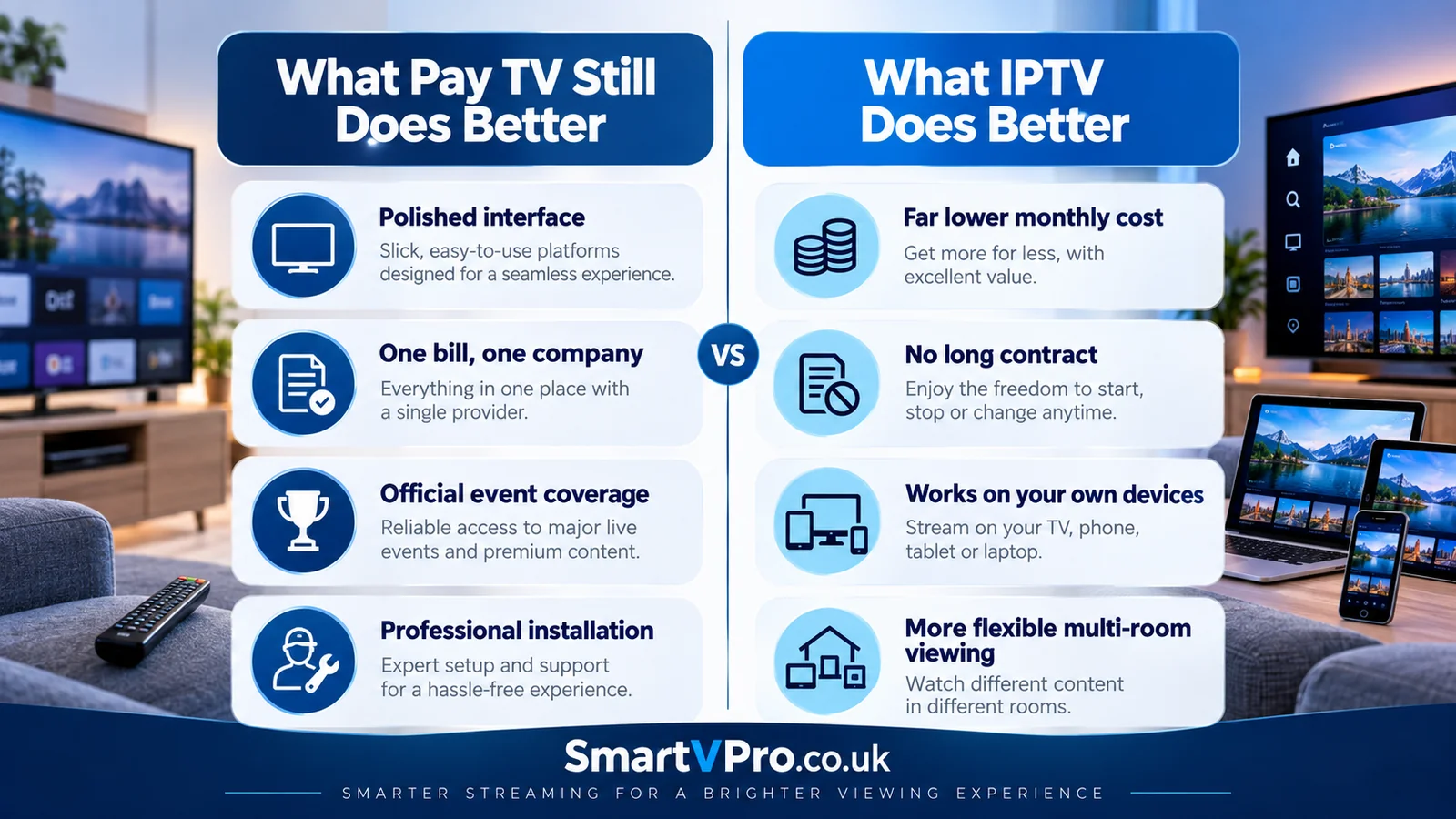
- Guaranteed polish. The interface, the remote, the voice search and the recording features are engineered by large teams and they just work. IPTV apps such as TiviMate get close, but you set them up yourself.
- One bill, one company to call. If something breaks, one provider owns the whole chain from dish to screen.
- Official 4K and premium audio on every event. IPTV delivers 4K where the source supports it; the platform that holds the rights controls the source.
- Zero technical effort. An engineer installs it. With IPTV you follow a setup tutorial, which takes five to ten minutes but is still something you do yourself.
If those four points are worth £1,600 over two years to you, pay TV is the right choice. For most of the people who search for IPTV vs pay TV, they are not.
IPTV vs Pay TV: What IPTV Does Better
- Price. £4–£11 a month against £60–£110 is not a close contest.
- No contract and no mid-term rises. Pay for a month or a year; the price you paid is the price.
- Your own hardware. Works on the smart TV, Firestick, Android box, phone or laptop you already own. No rental, no engineer.
- Multi-room without extra boxes. A 2, 3 or 4-device plan covers the whole house on the devices already in each room.
- Watch anywhere. The same login works on holiday, at a relative’s house or on the train, subject to your broadband.
- Breadth. UK, international, news, sport, films and series in one app rather than five subscriptions.
IPTV vs Streaming Bundles: The Broadband Versions of Pay TV
The big platforms now also sell their TV over broadband, with an app or a small puck instead of a dish, and some rolling monthly options. That makes the IPTV vs pay TV comparison closer on paper. The prices tell a different story. An entertainment-only streaming membership is under £10 a month, but a sports membership alone is typically £25–£35 a month on a rolling basis, and the full streaming package with sport still carries an 18-month contract with annual rises.
So the streaming versions remove the dish and the engineer, but they keep the pay-TV pricing structure. Against an established IPTV plan at £4–£11 a month covering every category, the gap remains large; it is simply a more modern version of the same trade-off.
| Streaming pay-TV option | Typical 2026 monthly price | Contract | Covers |
|---|---|---|---|
| Entertainment-only streaming membership | under £10 | Rolling | Entertainment channels and box sets |
| Sports streaming membership | £25–£35 | Rolling (cheaper on 6–12 month offers) | Sport only |
| Full streaming package with sport | £50–£90+ | 18 months, annual rises | Entertainment, sport, cinema |
| Established IPTV plan | £4–£11 | None | Live channels, sport, films, series, international |
Broadband: The One Requirement IPTV Adds
Satellite pay TV works without broadband; IPTV does not. In practice this changes very little, because nearly every household that considers IPTV vs pay TV already has a broadband line. The requirement is modest: about 25 Mbps for stable HD and around 50 Mbps for 4K, on a connection that holds up in the evening. Wired Ethernet or a 5 GHz Wi-Fi connection to the streaming device removes most of the remaining variability. If your broadband is bundled with your TV contract, ask for the broadband-only price at renewal; it is almost always lower than the bundle, and it is all IPTV needs.
Sport: Where the IPTV vs Pay TV Debate Gets Loudest
Sport is why most people open this comparison, because sport is what pushes a pay-TV bill from £15 to £80. The honest position is this: the rights-holding platforms control the official source, so they guarantee their own 4K events and their own commentary options. Established IPTV plans deliver live sports channels in the same plan price, with 4K where the source supports it, and cover a far wider international range in one app.
Which matters more depends on whether you watch one competition religiously or want everything under one roof. Either way, the IPTV vs pay TV cost difference for a sports household is the largest of any viewer type, because sport is exactly what pay TV charges most for.
IPTV vs Pay TV Over Five Years: The Long-Run Projection
Two-year totals understate the gap because pay-TV pricing compounds. Assuming the pattern of annual mid-contract increases continues and IPTV pricing stays flat, which is what the last five years suggest, here is the projection for one screen.
| Year | Pay-TV bundle with sport (cumulative) | Established IPTV, annual plan (cumulative) | Gap |
|---|---|---|---|
| 1 | about £900 | £48 (+£45 stick if needed) | about £810–£850 |
| 2 | about £1,850 | £96 | about £1,750 |
| 3 | about £2,850 | £144 | about £2,700 |
| 5 | about £5,000 | £240 | about £4,750 |
Even if IPTV prices rose by a third and you replaced your streaming stick twice, the five-year IPTV vs pay TV gap stays above £4,000 for a single screen and grows for multi-room households. These are round numbers and your own bill may sit above or below the range, but the shape of the comparison does not change.
IPTV vs Pay TV for Different Households
- Single viewers and couples gain the most in percentage terms: one screen, one annual plan, no boxes to rent.
- Families with three or four screens pay the platforms’ multi-room fees, which are often £10–£15 per extra box per month. A 4-device IPTV plan removes that entirely.
- Sports fans face the largest absolute gap, because sport is the most expensive pay-TV add-on. They should also be the most demanding about peak-time testing before switching.
- International households get breadth that pay-TV bundles rarely offer at any price: news, sport and entertainment from home countries in the same app as UK channels.
- Households that value zero effort may still prefer pay TV. If nobody in the house wants to install an app or follow a setup guide, the premium buys convenience.
What Happens to Your Box, Dish and Recordings When You Switch
A practical detail that catches people out. Rented boxes usually have to be returned within a set window after cancellation or you are charged for them, so keep the packaging and the returns label. Satellite dishes can stay on the wall; nobody collects them, and a future occupant may use one. Recordings stored on a pay-TV box are tied to the box and the subscription, so watch anything you care about before the end date.
IPTV handles this differently: catch-up lives on the provider’s side for the channels that support it, and on-demand libraries mean you rarely need to record at all. If recording matters to you, TiviMate on a Fire TV Stick can record to local storage, which our TiviMate guide covers.
Interface and Ease of Use: A Fair IPTV vs Pay TV Comparison
The incumbent interfaces are excellent and it would be dishonest to pretend otherwise: voice search across services, a unified recordings list and a remote that just works. IPTV apps have closed most of the gap. TiviMate offers a full grid guide, favourites, catch-up and multi-view; IBO Player gives a simpler channel-up, channel-down experience that older relatives find easier than a modern pay-TV menu.
What you lose is the single integrated ecosystem where one remote drives everything. What you gain is choice: if you dislike one app, install another in five minutes at no cost. For most viewers who have made the IPTV vs pay TV switch, the adjustment period is a week and the interface question stops mattering once the guide is set up the way they like it.
The Nuance: Reliability, Legitimacy and the TV Licence
Three caveats belong in any fair comparison. First, IPTV quality varies enormously between providers; a £3 reseller plan will make pay TV look brilliant by comparison. Use the ten criteria in our guide to the best IPTV providers in the UK and always test at peak time. Second, choose a provider that operates openly, publishes its terms, refund policy and a copyright notice, and answers support tickets.
Third, none of this removes the need for a TV licence: watching live television as it is broadcast requires one in the UK on any platform, and from April 2026 it costs £180 a year according to TV Licensing. Budget for it whichever side of IPTV vs pay TV you land on.

Switching From Pay TV to IPTV: A Practical Order of Operations
- Check your contract end date. Early exit fees can wipe out the first year of savings. Note the date and plan the switch around it.
- Run a peak-time IPTV trial now, on the TV you use most. Start the 24-hour trial for £1 and watch between 8pm and 10pm. Do not cancel anything until you are satisfied.
- Pick your app and device. A Fire TV Stick with TiviMate or our Firestick guide is the most common UK setup and takes ten minutes.
- Keep the broadband, drop the TV. If your broadband is bundled, ask for a broadband-only price at renewal; providers usually have one.
- Choose the plan length. After a successful trial and a busy weekend, an annual plan gives the lowest cost. Details in Cheap IPTV UK: what each price tier buys.
How SmartVPro Compares With Pay TV
If you are weighing up IPTV vs pay TV for your own home, here is our side of the ledger. We designed our UK plans as a direct alternative to a pay-TV bundle: one price covers 34,000+ live channels and 195,000+ on-demand titles, a maintained programme guide with catch-up, and 4K where the source supports it, on the devices you already own.
Single-device plans run from £10.99 monthly to £47.99 for a year, with 2, 3 and 4-device options on the plans page. There is no contract, no mid-term price rise, a £1 24-hour trial and a 7-day money-back guarantee. You can read what customers who switched say on our reviews page, and check the line-up on the UK channel list before you test.
Ready to see real numbers on your own TV? Start the 24-hour SmartVPro trial for £1, test it during peak evening hours, and only then decide whether a monthly, 3, 6 or 12-month plan makes sense for your household. Every plan is covered by a 7-day money-back guarantee.
IPTV vs Pay TV: Frequently Asked Questions
Is IPTV cheaper than pay TV in the UK?
Yes, by a wide margin. A satellite or cable bundle with sport typically costs £60–£110 a month on a long contract, while an established IPTV plan costs £4–£11 a month with no contract. Over two years the IPTV vs pay TV difference is usually more than £1,600 for one screen.
Can I keep my cable broadband and use IPTV?
Yes. Cable broadband speeds are more than enough for 4K IPTV. Many households keep the broadband and drop the TV package at the end of the contract.
Do I need a dish or a box for IPTV?
No. IPTV runs on a smart TV, Fire TV Stick, Android box, phone or laptop you already own. There is nothing to install on the outside of the house.
What does pay TV do better than IPTV?
A polished interface with recording and voice search, one bill and one company to call, guaranteed 4K on official events, and professional installation. If those matter more to you than the IPTV vs pay TV cost difference, the incumbents are the right choice.
Do I still need a TV licence if I switch to IPTV?
Yes. A TV licence is required in the UK to watch or record live television as it is broadcast on any platform. From April 2026 it costs £180 a year.
Is IPTV reliable enough to replace satellite or cable?
An established provider tested at peak time, yes. A cheap reseller, no. Reliability is about the provider you choose, which is why we recommend a paid peak-time trial before cancelling anything.
Are there exit fees when leaving a pay-TV contract?
Usually, if you leave before the minimum term ends. Check your contract end date and plan the switch around it rather than paying early termination charges.
Can IPTV cover multiple rooms without extra boxes?
Yes. A 2, 3 or 4-device plan lets you stream simultaneously on the devices already in each room, without renting additional set-top boxes.
Get the next IPTV guide by email
New setup guides, app comparisons and buffering fixes for UK viewers – about two emails a month, no spam, unsubscribe in one click.